
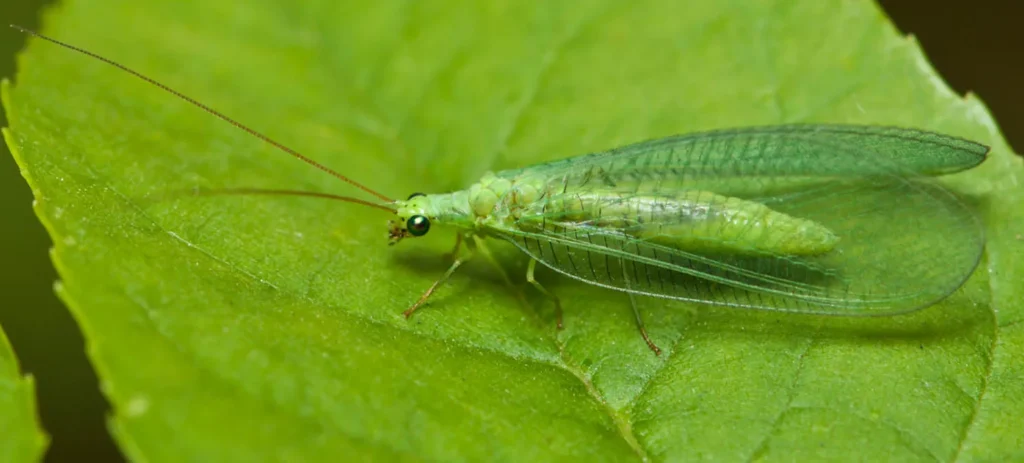
Green lacewings (genus Chrysoperla)
are beneficial predatory insects widely used in sustainable agriculture
and greenhouse production.
Their larvae, often called “aphid lions,”
prey on a wide range of soft-bodied pests, offering a natural pest management method that supports ecological balance and reduces chemical
pesticide use.
Green lacewing larvae are most effective against aphids, spider mites,
whiteflies, thrips, scale crawlers, and mealybugs.
They consume large
quantities of these pests—an individual larva can eat hundreds of aphids
during its development period.
Additionally, they help suppress small
caterpillar stages and moth eggs, providing broad-spectrum pest control.
Green lacewings fit perfectly into IPM programs by controlling pest
populations biologically and reducing reliance on synthetic
insecticides.
They can be combined with selective pesticides, and their
presence enhances beneficial insect biodiversity on crops.
Their use aligns with eco-friendly farming certifications and supports compliance
with EU agricultural subsidies promoting reduced chemical inputs.
The life cycle includes egg, larval, pupal, and adult stages, typically completing within 3-6 weeks depending on environmental conditions.
Females deposit eggs on stalks to protect from cannibalism. Larvae feed
voraciously before pupating.
Adults overwinter in protective habitats
like leaf litter or bark crevices, emerging in spring, which ensures
their population sustainability across seasons.
Green lacewings adapt
well to various climatic zones and crop environments.
Mass rearing involves producing eggs and larvae on carrier cards or in
specialized units, allowing timed and controlled release by growers.
Field application methods include manual release, greenhouse blowers, or
drone dispersal for large-scale coverage.
Regular releases during pest
outbreaks are recommended to sustain control.
Providing flowering plants
nearby supports adult nutrition and longevity.
Environmental conditions such as temperature and humidity influence their development and predation rates.
Broad-spectrum insecticides are harmful to the insect and will affect it, if released.
Combine with monitoring tools for precise release timing and efficient pest suppression.
For large-scale farms seeking sustainable pest control solutions, green
lacewings provide an ecologically sound, proven, and cost-effective
strategy to minimize pesticide use and improve crop health.
No, Green Lacewings are completely harmless to humans, pets, and other beneficial insects—they’re safe predators that only target pest eggs and soft-bodied bugs like aphids.
No, Green Lacewings won’t wipe out every pest—they voraciously eat hundreds of aphids, mites, and eggs per larva, but leave some survivors depending on density and conditions. Perfect for strong suppression in IPM!
Green Lacewings are released as eggs on cards, loose larvae via blowers, or pupae—pin them under leaves, scatter in greenhouses, or drone-disperse for fields at pest hotspots.
Yes, Green Lacewings are perfect for organic farming—approved biocontrol agents that slash pests without chemicals, fully compliant with certifications!
Optimal temps (20-28°C) and 70-80% humidity boost Green Lacewing predation; cold slows development, heat stresses them, and low humidity dries eggs—release during mild weather for max impact!
Green Lacewings mainly target pest insects and have minimal impact on non-target species, supporting overall biodiversity and natural pest balance in crops.
However, introducing or augmenting populations with non-native or high-density strains can pose some risks. These introduced wasps may parasitize eggs of non-target native insects, potentially altering local insect communities and biodiversity. Therefore, biological control programs must carefully assess ecological risks and monitor effects on non-target species, especially when using non-native Trichogramma strains.
In areas where Trichogramma are naturally present without intervention, their impact on biodiversity is typically low and part of the natural ecological balance.